English
  日本語
日本語  한국어
한국어  français
  Deutsch
  Español
  italiano
  русский
  português
  ไทย
ไทย  Malay
Malay 

A Procurement-Focused Guide to Data Integration, Live Operations, and Total Cost of Ownership
Introduction: The Procurement Bottleneck No One Talks About
When a security supervisor at a logistics warehouse needs to review an incident from three shifts ago, they often spend hours docking dozens of cameras—only to discover that one critical device never uploaded. This isn't a hardware malfunction; it's a data management gap.
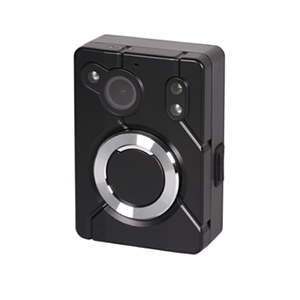
Recoda DVR Wi-Fi Body Cameras were built to close this gap. With automatic wireless uploading, cloud-based evidence management, and enterprise-level durability, they transform body cameras from passive recorders into active operational tools.
1. Data Management: From Docking Stations to Zero-Touch Archiving
The Problem: Manual data transfers drain staff hours and create chain-of-custody risks.
The Solution:
Set-and-Forget Wi-Fi Syncing
Cameras auto-connect to secure Wi-Fi within coverage.
Full uploads complete in under 90 seconds.
Priority tagging ensures emergency clips transmit first via 4G backup.
End-to-End Evidence Management
AES-256 encryption with blockchain-based custody logging.
Integrates seamlessly with Milestone VMS and Genetec via open API.
Flexible Storage Models
| Option | Cost Model | Retention Policy |
|---|---|---|
| On-premise server | One-time purchase | Up to 10 years |
| Cloud (AWS Gov) | Subscription-based | 30 days–5 years |
"Every file is watermarked with a SHA-256 hash. Any tampering voids admissibility—protecting both evidence and your organization."
Related Reading: mobile DVR vs dash cam
2. Real-Time Operations: Turning Crisis into Controlled Response
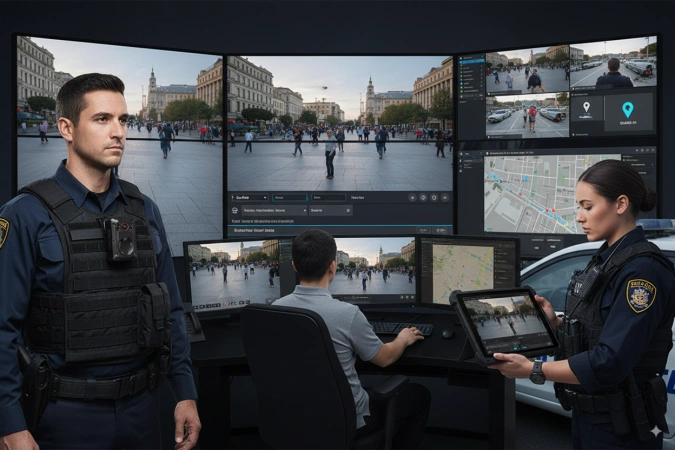
The Problem: Supervisors lack live visibility when incidents escalate.
The Solution:
Low-Latency Streaming
<300 ms on stable Wi-Fi; seamless handover to 4G LTE.
Remote supervision dashboards for multi-guard monitoring.
Tactical streaming to first responders in emergencies.
No Missed Moments
Auto-recording triggers on gunshot detection, sirens, or panic-button activation.
Remote supervisors can start recording silently via mobile app.
Result: Situations shift from chaotic to coordinated, in real time.
3. Hardware Durability: Built for 12-Hour Shifts, Rain or Shine
The Problem: Devices fail under extreme field conditions.
The Solution:
Shift-Proven Battery Life
6,800 mAh battery supports 10 hours live-streaming or 14 hours scheduled sync.
Hot-swappable design eliminates downtime.
Rugged Engineering
IP68 waterproof + dustproof.
3 m drop resistance, MIL-STD-810G certified.
Superior Audio-Visual Performance
1440p HD video + 140° wide-angle lens.
Starlight night vision down to 0.1 lux.
With RecodaDVR, a 12-hour patrol doesn't mean a 12-hour worry about battery and reliability.
4. Total Cost of Ownership: Looking Beyond Unit Price
The Problem: Procurement teams focus on upfront cost, not lifecycle ROI.
The Solution:
Transparent Costing
Cost Component RecodaDVR Industry Average Hardware per unit $299 $320–$400 Cloud EMS (per device/mo) $9.99 $15–$25 On-premise software One-time $999 $1.2K/year Scalability
Start with 10 cameras; expand to 10,000—no software rebuild required.
Centralized management across multi-site deployments.
Support Services
3-year warranty + 24/7 tech support (15-min SLA).
Free 30-day pilot program for up to 5 cameras.
ROI isn't about cost savings alone; it's about future-proofing evidence management and operational readiness.
Conclusion: From Procurement to Performance
A body camera is no longer just a compliance checkbox. With Wi-Fi sync, cloud EMS integration, real-time streaming, and enterprise durability, RecodaDVR Wi-Fi Body Cameras deliver measurable ROI and peace of mind.
Ready to explore the right fit for your needs? Contact us to learn more,