English
  日本語
日本語  한국어
한국어  français
  Deutsch
  Español
  italiano
  русский
  português
  ไทย
ไทย  Malay
Malay 
Imagine a critical traffic stop. An officer notices a suspect hastily attempting to delete a navigation route or a text message on their vehicle's massive digital dashboard. The officer steps in, positioning their Body Worn Camera (BWC) to capture the screen as crucial evidence.
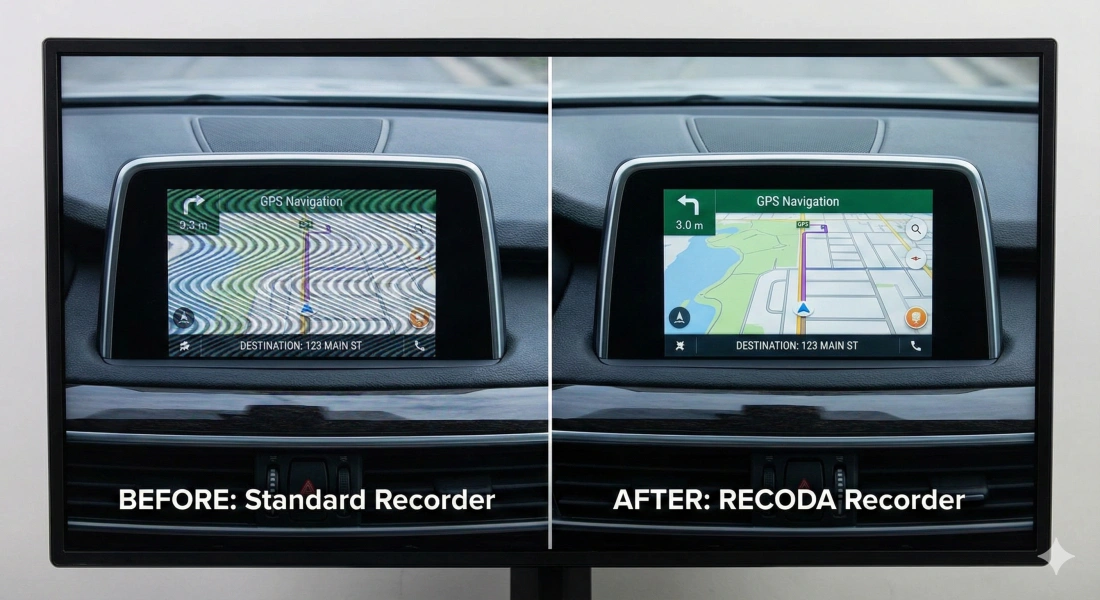
But there’s a critical failure during evidence review: the footage of the screen is a strobing, garbled mess covered in strange wavy lines. The text is entirely unreadable.
In an era where modern vehicles are essentially rolling computers with high-refresh-rate OLED and LED screens, capturing clear footage of digital dashboards is a modern policing necessity. Yet, most standard BWCs fail at this due to two distinct optical phenomena: The Moiré Effect and Refresh Rate Flicker.
At RECODA, we engineer our BWC sensors to account for these exact edge cases. Here is the technical breakdown of why digital screens distort on camera, and how advanced sensor calibration solves the problem.
The Problem: Why Digital Screens Look Terrible on Camera
When a BWC records a digital screen, it is essentially a grid of pixels (the camera sensor) trying to capture another grid of pixels (the dashboard screen). This clash creates two major visual distortions:
1. The Moiré Effect (Spatial Distortion)
The Moiré effect occurs when two finely detailed grid patterns overlap at a slight angle or different scale. When the pixel grid of the vehicle's display misaligns with the pixel matrix of the BWC's CMOS sensor, it creates strange, wavy, rainbow-colored bands across the image.
These artificial patterns can completely obscure small text, such as a GPS coordinate or a phone number, rendering the video useless for evidentiary purposes.
2. Screen Flicker and Banding (Temporal Distortion)
Digital screens do not emit continuous light; they pulse. Many automotive displays use Pulse Width Modulation (PWM) to dim the screen, flickering faster than the human eye can see. However, the BWC's electronic shutter operates at its own speed. If the camera's shutter speed and the screen's refresh rate (e.g., 60Hz or 120Hz) are out of sync, the resulting video will show severe dark bands rolling down the screen or aggressive strobing.
How Advanced BWCs Eliminate Screen Distortion
Standard, consumer-grade cameras rely on basic Auto-Exposure (AE) algorithms designed for faces and landscapes. To capture digital evidence inside a suspect's vehicle clearly, a law enforcement BWC requires specialized hardware and firmware calibration.
1. Anti-Flicker Firmware Calibration (Shutter Sync)
To eliminate rolling bands and strobing, the BWC's firmware must feature advanced anti-flicker technology. By automatically detecting the frequency of the artificial light source (typically 50Hz or 60Hz depending on the region and screen technology), the BWC dynamically adjusts its electronic shutter speed to match.
Instead of a fixed shutter speed that clashes with the dashboard’s PWM, the calibrated BWC syncs its exposure time to capture complete frames of the screen without catching the "dark phase" of the display's flicker.
2. Advanced ISP (Image Signal Processor) Tuning
The Moiré effect is notoriously difficult to fix after the fact. The solution must happen in real-time. High-end BWCs utilize specialized Image Signal Processors (ISPs). These processors use edge-detection and noise-reduction algorithms to identify the high-frequency artificial patterns caused by the pixel grids. The ISP applies localized micro-smoothing to the interfering grid lines while preserving the sharpness of the actual text on the screen.
3. Optical Low-Pass Filters (OLPF)
At the hardware level, premium camera modules can incorporate an Optical Low-Pass Filter (OLPF) directly over the CMOS sensor. The OLPF introduces a microscopic amount of blur—just enough to break up the harsh geometry of the vehicle screen's pixel grid before the light hits the camera sensor. This physical intervention stops the Moiré interference pattern from ever forming, ensuring the recorded footage is a true representation of the dashboard.
Securing the Digital Evidence Chain
As digital screens become ubiquitous in vehicles and mobile devices, "screen-to-camera" recording is no longer an edge case—it is a daily law enforcement requirement.
When upgrading your department's BWC fleet, it is vital to look beyond basic megapixel counts. Test the cameras against modern vehicle dashboards, tablets, and smartphones. At RECODA, our rigorous sensor calibration ensures that when an officer needs to capture fleeting digital evidence, the footage is clear, readable, and ready for court.